
This updated Life After High School 2025 report examines the economic and educational realities facing young New Orleanians, many of whom had their K-12 experiences greatly altered by the COVID-19 pandemic.
Introduction
High school graduation represents a pivotal milestone in a young person’s journey, as the choices made during this time often determine the course of their future.
In 2019, the Cowen Institute released the first Life After High School report, along with an accompanying website, to explore the education and employment pathways of New Orleans youth ages 16 to 24.
Over the past six years, we’ve continued to chronicle the postsecondary employment and educational outcomes for New Orleans public high school graduates. Building off our previous reports, this updated Life After High School 2025 report examines the economic and educational realities facing young New Orleanians, many of whom had their K-12 experiences greatly altered by the COVID-19 pandemic.
This report begins with an overview of the demographics of New Orleans to offer context on the city’s employment landscape and information on its declining population. We then analyze publicly and privately available data on current jobs and wages in the city, with a focus on industries that employ larger numbers of 18-24 year olds, as well as the earnings of those young adults. We also look at postsecondary education data, with a focus on enrollment trends among historically excluded populations to examine whether students are not just matriculating to college, but also persisting.
For this report, we relied on two main data sources. The economic data came from Lightcast.io. Lightcast is a provider of proprietary labor market data, combining publicly available labor data and the company’s own analytics to produce its projections and data overviews. The postsecondary education outcome data came from the Louisiana Department of Education.
With this report, we aim to provide a descriptive summary of the educational and employment outcomes of young people in New Orleans between the ages of 16-24. Data on the local and national economy, as well as on postsecondary education, can support young adults and families make better-informed decisions about career and educational pathways.
While we have used some of the best economic and educational data sources available (see the methodology section for a full breakdown), no amount of data can ever construct a complete picture of the individual experiences of every young person in the city. We hope that this report serves as a foundation for a broader discussion about the employment and educational opportunities available to young people in our city.
Special Thanks To Our Funders
We want to thank the Carnegie Corporation of New York and The Booth-Bricker Fund for their generous support of Life After High School 2025.
New Orleans Demographics
In order to contextualize the economic and educational data presented in this report, we’ll begin by presenting a demographic overview of the New Orleans population. Here are some key facts to keep in mind as you read the report:
The Population

The population in Orleans Parish in 2025 was an estimated 357,590 people, which was a decline of more than 6,000 from the population in 2024 (363,937). This marks a continued decline in the city’s population: since 2019, the population has decreased by almost 9%, with a net loss of 33,582 people. Lightcast forecasting data projects the population to continue to decline over the next five years, with an expected decrease of another 8%, or 30,000 people, by 2029. The largest declines have occurred for those aged 20-39: the city has lost 22,000 people in these age groups over the past five years, a drop of 19%. As these are people who are of peak working age, this could have a negative effect on the city’s economy both now and in the future. Additionally, this data, coupled with declining enrollment in the earliest grades in New Orleans’ schools, suggests the city’s population decrease could continue for the foreseeable future.
As we noted last year, a declining population can have significant negative impacts on the city’s economy and public services. Fewer residents means fewer people to support local businesses and pay property taxes. The population decrease therefore should be viewed as a potential problem for city leaders and the economic viability of the city long-term.
New Orleans is more racially diverse than the U.S. as a whole, though the racial demographics of the city have changed notably over the past five years. The percentage of the population that is Black or White has dropped by 12% and 7%, respectively; conversely, the percentage of the population that is Hispanic has increased by 5%. It’s also worth noting the percentage of the population that is Black has continued to decline over the time we have done this report. Overall, in 2024, an estimated 55% of the population in New Orleans was Black (57% last year), while 31% were White non-Hispanic (32% in 2024), 7% were White Hispanic (4% in 2024), and 3% were Asian (the same rate as in 2024).
With regards to gender, the city’s demographics remained the same from 2024 to 2025: 53% of the population in New Orleans identified as females, and 47% as males. (Note: Labor data does not include non-binary individuals.)
In 2025, 22% of the city’s population was 19 years old or under and 13% of the population was between 15 and 24 — the same rates as in 2024. 58% of the population was between 20 and 60 years old and just 4% of the population was 80 years old or above. According to Lightcast demographic data, based on the age of the population, the city has a lower than average rate of millennials and an average rate of people approaching retirement compared to ratios across the country.


Educational Attainment
Educational attainment levels in New Orleans are on par with the national average and notably higher than in Louisiana as a whole.
In 2025, 23% of Orleans Parish residents held a Bachelor’s Degree (about 1% above the national average). 48% of New Orleanians had some form of a postsecondary degree (Associate’s, Bachelor’s, or a graduate degree), which was notably higher than the rate for all Louisiana residents of 34%. Additionally, 32% of New Orleans residents had only a high school degree or less, which was better than the state rate of 45%.
However, in New Orleans, there were significant educational attainment disparities along racial lines: in 2025, around 70% of White New Orleans residents had a college degree compared to around 29% of Black New Orleanians. Additionally, nearly 18% of Black residents had not earned a high school diploma, compared to only 3% of White residents. A high school degree was the highest level of educational attainment for the majority of Black city residents.
These differences in educational attainment likely play a significant role in the economic and employment disparities between White and Black city residents, in terms of both income levels and employment rates.
Inbound and Outbound Migration
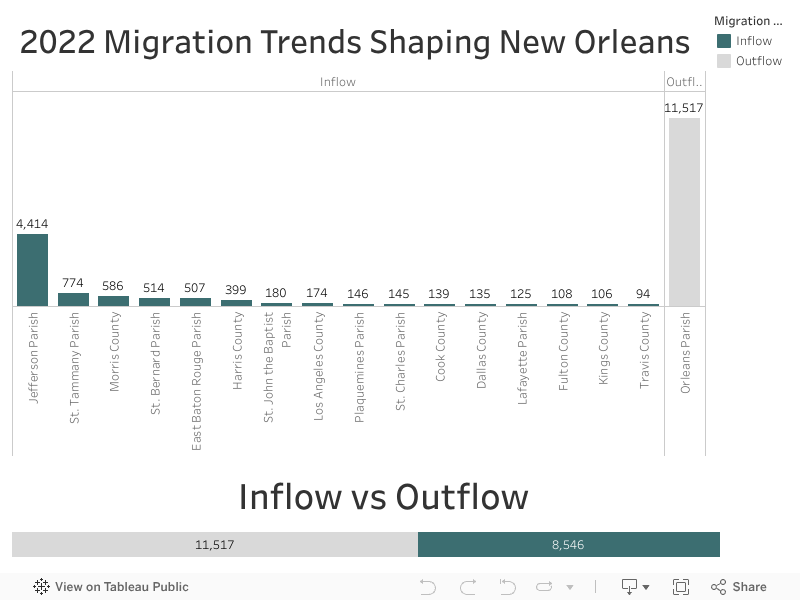
As in previous editions, Life After High School 2025 examines patterns of inbound and outbound migration to better understand how residents are engaging with the educational, economic, and lifestyle opportunities available in New Orleans. Migration trends can offer important insights into whether the city is retaining and attracting young people and families, or losing them to surrounding areas.
Consistent with the city’s overall population decline over the past five years, migration data shows that New Orleans experienced a net loss of residents in 2022 (the most recent year for which data were available). That year, 5,435 more people moved out of the city than moved in. The most common destination for former New Orleans residents was neighboring Jefferson Parish, which saw 5,193 new residents from Orleans Parish—roughly 700 more than the number who moved in the opposite direction. Other top destinations included St. Tammany Parish, Harris County, Texas, St. Bernard Parish, and East Baton Rouge Parish.
Economic Data
New Orleans’ economy shrank during the pandemic and has continued to stagnate in the years since. The city’s total number of jobs has declined significantly over the past five years — though Lightcast does project that the city will undergo moderate job growth over the next five. However, New Orleans high school students are not graduating into a thriving local or regional economy. Overall, the New Orleans economy is still heavily reliant on tourism. One of the major drawbacks of this reality is that the industries in this sector, such as Accommodation and Food Services, along with Retail, pay some of the lowest wages of any of the 20 largest industries tracked in labor data. That impacts the overall median earnings of all New Orleans residents. The city’s median household income for 2023 (the last year for which data is available) was $55,339, which was approximately 30% less than the national median of $78,500.
Job Growth

New Orleans has not experienced a post-pandemic economic recovery in the same way as other cities or metro areas. According to Lightcast data, from 2019 to 2024, the number of jobs declined by 5.2% in Orleans Parish (up from 4.4% from the 2018 to 2023 period we chronicled in last year’s report) from a total of 232,982 to 220,866. Notably, during this period, the national growth rate was 4.3%, meaning that New Orleans trailed the national average by 9.5%.
Unemployment
One positive factor for the local economy, however, is that even as the number of jobs declined in New Orleans overall, the labor force participation rate actually increased from 58.1% to 59.2% between 2019 and 2024. The labor participation rate is a calculation of the number of people working divided by the total working-age population. The unemployment rate in the city is slightly higher than it was before the pandemic. In August 2025, the unemployment rate was 4.5%, whereas in August 2019, it stood at 4.3% (it reached a high of 18.4% in April 2020).
Black New Orleanians have disproportionately high rates of unemployment compared to overall city demographics. Despite the overall demographics of the city and the fact that Black residents make up the majority of the population, only 37% of all jobs were held by Black residents in 2023, while 51% were held by White residents. Additionally, as of June 2025, 73% of the people unemployed in New Orleans were Black, while only 26% were White. These numbers suggest race could play a factor in terms of employment, hiring, and job availability in New Orleans.
Industries
As we noted last year, following the pandemic, Accommodation and Food Services has once again re-emerged as the largest industry in terms of total number of jobs in the city (Government was the largest employer in 2020 and 2021 — it has been second for the past two years). The city has twice the number of Accommodation and Food Services jobs as the national average for a city of its size, with nearly 36,726 total jobs or around 17% of all jobs in the city. Government is the second largest industry in the city with almost 32,000 total jobs.
As was true in our 2024 report, Health Care and Social Assistance and Educational Services were the two other largest industries based on job totals in the city, with the number of jobs in Educational Services being nearly five times the national average for a city of New Orleans’ size.
The city’s relatively weak economy is also evidenced by the low number of jobs in industries like Manufacturing, Finance, and Construction compared to national averages. These industries have far higher average annual salaries than New Orleans’ largest industrial sectors. This again points to weaknesses in the New Orleans economy overall due in part to a lack of economic diversity.
As was true in 2023, Accommodation and Food Services was also the largest industry employer of 14-24 year-olds in the city, indicating that many New Orleans youth who decide to enter the workforce are doing so in this industry after they leave high school: 28% of young adults in that age bracket worked in the Accommodation and Food industry, including 44% of 14-18 year-olds. Government and Retail Trade were the two other largest industries for youth 14-24 to work in based on the total number of jobs.
This matters in part because Accommodation and Food Services in New Orleans is an industry with some of the lowest wages and highest relative rates of unemployment. Accommodation and Food Services had the third highest turnover rate (116%) of the top 20 industries as well, indicating that employment in the industry is not always stable. The average annual earnings of those working in Accommodation and Food Services was $40,678 in 2024, which was the lowest average of the 20 largest industry employers in the city. (As a means of comparison, MIT’s Living Wage Calculator estimates that an adult with one child needs an income of $73,819 in Orleans Parish to meet all their expenses). By contrast, the city has very few jobs in the industries in the city with the highest average annual earnings. Mining, Quarrying, and Oil and Gas Extraction, Utilities, Management of Companies and Enterprises, and Finance (all of which have average earnings of over $150,000), collectively employ around 8,500, which is less than a fourth of the number of jobs in the Accommodation and Food Services sector.
As we have concluded in previous issues of this report, New Orleans has a low number of high-paying jobs and those that do exist are disproportionately held by White individuals. This data suggests that many New Orleanians who leave high school face a relatively limited labor market.


In Demand Skills and Growth Industries
We also wanted to use available economic data to examine which professions offered young people in the city the greatest opportunities to find employment. According to Lightcast data, the skills that are most in demand from employers in the city are:
- Occupational Safety And Health
- Nursing
- Medical Privacy
- Communicable Diseases
- Restaurant Operation
- Marketing
- Project Management
- Auditing
- Data Entry
- Accounting
The top growing occupations in the city were in the following areas:
- Management
- Healthcare Support
- Healthcare Practitioners and Technical
- Business and Financial Operations
- Installation, Maintenance, and Repair
- Legal
- Life, Physical, and Social Science
Lightcast also analyzes job postings to identify trends in the professions most in demand and actively hiring in the city. According to that data set, the occupations with the top monthly postings are:
- Healthcare Practitioners and Technical
- Management
- Food Preparation and Serving Related
- Sales and Related
- Office and Administrative Support
These trends suggest that many of the better employment opportunities in the city will require young people to receive additional education and training after graduating from high school.
Postsecondary Data
The data in this section focuses on the outcomes for New Orleans high school students at postsecondary institutions. It presents college enrollment rates cumulatively, and broken down by each high school in the city. Additionally, it examines college re-enrollment rates for the city’s high school graduates — this is the percentage of students who re-enroll in and continue their postsecondary education after completing their first year. The data comes from the Louisiana Department of Education and much of it was also summarized in our State of Public Education in New Orleans 2025 report.
In order to have a comprehensive perspective on the data, it’s important to understand some basic demographic information about New Orleans students and the context of public education in the city. New Orleans’ public education system is notable for its governance model. All but one of the city’s 71 public schools is a not-for-profit charter school. New Orleans Public Schools (NOLA-PS) directly runs one school in the city, but is the authorizer and governing authority for the vast majority of public schools in the city.
As of October 2024, there were 47,667 PreK-12 students enrolled in public schools in New Orleans, including schools overseen by NOLA-PS, Type 2 charter schools (Type 2 charters are those overseen by the Louisiana State Board of Education, which is frequently referred to as BESE), and one school overseen by the State Legislature. The city’s schools serve primarily students of color (90%), which is far higher than the state rate of 59% for public school students. New Orleans public school students typically come from lower socioeconomic households, with 85% qualifying as economically disadvantaged (ED). The city’s public schools have a far higher rate of Black students (71%) than all public schools statewide (42%). There is also a higher rate of Hispanic students in Orleans Parish public schools (15%) than across the state (12%), while there is a lower percentage of White students (10% in Orleans Parish, 41% in Louisiana). There has been an increase in the number of White and Hispanic students in public schools over the past decade (though the percentage of ED students has remained relatively stable). It is also important to note that total enrollment in all public schools in New Orleans has dropped by 7% from 2019-2020 to 2024-2025. This represents a drop of around 3,500 students.
Enrollment in most public schools in New Orleans follows a school choice and “open enrollment” model. Students are not assigned to neighborhood schools according to geographic catchment zones. Instead, families rank their top schools and NOLA-PS then assigns students to schools using an algorithm that prioritizes a number of factors, such as whether a sibling of the student attends the school and how close the student lives to the school. Yet, despite the citywide open enrollment policies, inequities persist along racial and economic lines.
While academic performance and high school graduation rates in New Orleans saw a dramatic increase in the first decade after Hurricane Katrina, they have stagnated in recent years. The 2022-2023 cohort graduation rate for public school students in the city was 79%, which was a slight drop from a recent high of 80% in 2019-2020. The cohort graduation rate in Orleans Parish has consistently trailed that for the state of Louisiana over the past decade as well. The state rate in 2022-2023 was 83%.
College enrollment among students from New Orleans public high schools has increased over the past decade and has been higher than the rate statewide during that duration. In 2022-2023, 65% of New Orleans high school graduates matriculated to college (up from 59% in 2021-2022), compared to 57% of students statewide.
Yet, notably, New Orleans public school graduates persist into their second year of college at lower rates than all Louisiana students. The overall persistence rate for New Orleans public high school graduates was 69%, which was lower than the state rate of 77%. The New Orleans persistence rate includes a 63% rate for Black students and a 64% rate for economically disadvantage students, both of which also trail state averages (69% for Black and 70% for ED students statewide, respectively). New Orleans students’ persistence rates have trailed the statewide average for the past decade and also highlight the continued difference in outcomes for White and Black students in the city. While Black students persist at lower rates than Black students statewide, White students persist at higher rates, with 92% re-enrolling for their second year, compared to 82% of White students in all of Louisiana. Overall, while New Orleans schools, educators, policymakers, and stakeholders have succeeded at getting more high school graduates to college, they must also explore solutions that ensure students don’t just matriculate to college, but actually persist and graduate from it.


Conclusion and Recommendations
With the transition to a new city administration, New Orleans is positioned to strengthen coordination among government, education, and community partners to better support young people after they graduate from high school. In our 2025 Annual Poll of Parents’ and Guardians’ Opinions on K-12 Public Education in New Orleans, we found near universal agreement that city leaders, social services, and the justice system should do more to help New Orleans public schools on issues like truancy and transportation. We recommend that such collaboration also extends to supporting students both during high school and once they matriculate into postsecondary institutions and the workforce.
City leadership, including the mayor’s office, city council, the Orleans Parish School Boards, charter school leaders, and education stakeholders, should collaborate to develop a shared strategy focused on postsecondary readiness and success. This strategy could include:
- Data Sharing and Accountability: Establish mechanisms for sharing data on high school graduates’ postsecondary enrollment, employment, and training outcomes to identify gaps and measure progress.
- Resource Alignment: Coordinate city and school-based investments in career and technical education, youth employment programs, and postsecondary advising to maximize impact and reduce duplication.
- Cross-Sector Governance: Create a joint working group or advisory council to guide policy development, monitor implementation, and ensure that student and community voices inform decision-making.
- Economic Development: Given the report’s findings that New Orleans’ economy remains concentrated in lower-wage industries such as tourism and retail, the city and its partners should continue pursuing strategies that expand and attract higher-wage sectors. We recognize that this is complex work and that organizations such as the New Orleans Business Alliance, Greater New Orleans, Inc., and others are already advancing these efforts. Continued coordination and investment will be critical to ensuring that economic growth translates into broader opportunity for young residents.
- Education and Workforce Preparation: Because many of the city’s growing occupations require postsecondary education or specialized training, schools and workforce organizations should continue preparing students for high-wage, high-demand careers. We acknowledge that many partners, including YouthForce NOLA, the New Orleans Career Center, and local colleges, are already deeply engaged in this work. Sustained collaboration across sectors can help ensure that more young people not only access these opportunities, but are equipped to succeed in them.
Conclusion
The findings of Life After High School 2025 illustrate both the progress New Orleans has made and the challenges that remain in ensuring young people have access to college and meaningful, well-paying career pathways. The city’s economy continues to evolve, but its concentration in lower-wage sectors limits opportunities for many young adults, particularly those from historically marginalized communities. At the same time, New Orleans’ educators, workforce organizations, and economic development leaders are working to build stronger connections between education and employment. By sustaining and deepening collaboration across sectors, aligning economic growth strategies with workforce preparation, and continuing to invest in students’ postsecondary success, we hope that New Orleans can create a more inclusive and resilient economy that enables every young person to thrive after high school.