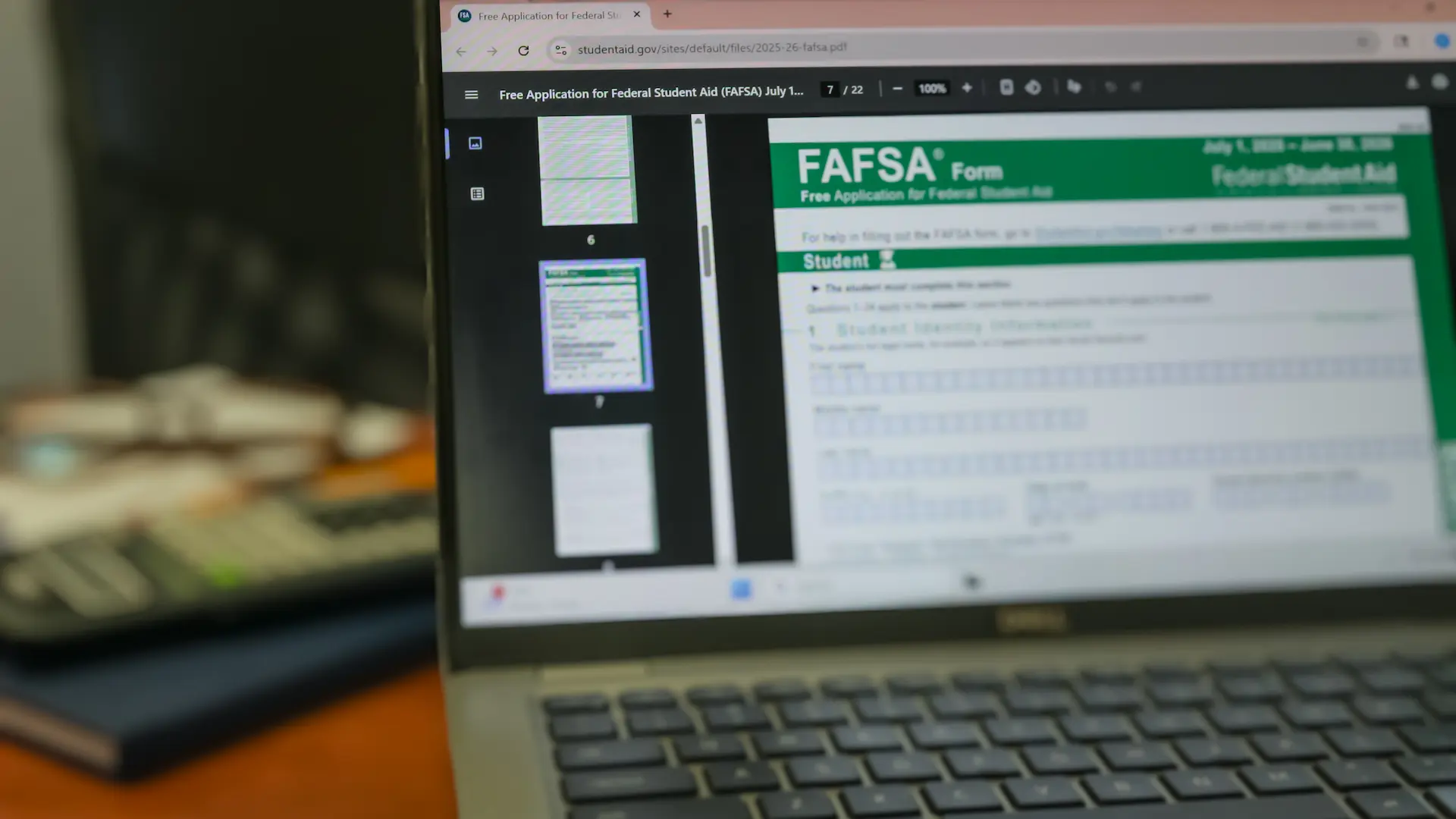
Welcome to FAFSA in New Orleans, a site containing FAFSA resources for students, families, and counselors as well as a FAFSA completion tracker for schools in the city.
Welcome to FAFSA in New Orleans, a site containing FAFSA resources for students, families, and counselors as well as a FAFSA completion tracker for schools in the city. This year’s FAFSA completion site is sponsored by The Kresge Foundation.

Resources
At the Cowen Institute, we’ve put together a few easy-to-follow resources for students with non-traditional needs and for students who have been flagged for verification. We also have Spanish versions of resources for students with non-traditional needs and those with questions about verification. We hope you find these guides helpful. In addition to our work, there are a number of excellent resources available to help students, families, and educators navigate the FAFSA application, submission, and completion process.
Resources for Students
The official step-by-step FAFSA Guide for the 2024-2025 school year can be found here. The guide provides detailed information on every question in the FAFSA and how to answer it.
There is a helpful, step-by-step video walk-through for the 2024-2025 FAFSA. You can access it here.
The Federal Student Aid office has a series of short, informative videos to help with FAFSA completion. Topics including creating your FSA ID and what to do if you lost your FSA password. You can find all the videos on their YouTube channel here.
The Louisiana Department of Education offers a variety of FAFSA support materials for students, counselors, and families. The U.S. Department of Education also offers a library of helpful videos.
Resources for Families
The official step-by-step FAFSA Guide for the 2024-2025 school year can be found here. The guide provides detailed information on every question in the FAFSA and how to answer it.
There is a helpful, step-by-step video walk-through for the 2024-2025 FAFSA. You can access it here.
The Federal Student Aid office has a series of short, informative videos to help with FAFSA completion. Topics including creating your FSA ID and what to do if you lost your FSA password. You can find all the videos on their YouTube channel here.
The Louisiana Department of Education offers a variety of FAFSA support materials for students, counselors, and families. The U.S. Department of Education also offers a library of helpful videos.
The Federal Student Aid office has a series of short, informative videos to help with FAFSA completion. Topics including creating your FSA ID and what to do if you lost your FSA password. You can find all the videos on their YouTube channel here.
Resources for Counselors
The official step-by-step FAFSA Guide for the 2024-2025 school year can be found here. The guide provides detailed information on every question in the FAFSA and how to answer it.
There is a helpful, step-by-step video walk-through for the 2024-2025 FAFSA. You can access it here.
The Federal Student Aid office has a series of short, informative videos to help with FAFSA completion. Topics including creating your FSA ID and what to do if you lost your FSA password. You can find all the videos on their YouTube channel here.
The Louisiana Department of Education offers a variety of FAFSA support materials for students, counselors, and families. The U.S. Department of Education also offers a library of helpful videos.
They also offer a number of training sessions. Learn more here.
New Orleans educators have also put together a growing list of resources here.
Georgetown’s Center on Education and the Workforce has a number of infographics and reports (as well an interactive on college majors and earnings in each state) that can help explain the value of credentials and the importance of choosing a major wisely. Find them here.
Louisiana Office of Student Financial Assistance (LOSFA)
If you would like to request an event that includes FAFSA Completion Workshops, please visit this link for more information.
FAFSA Completion By School for 2025-2026
May 2025 FAFSA Completion Data for All New Orleans Parish Public Schools
Pull Date: May 31, 2025
Below is the estimated percentage of FAFSA applications completed, per school. Calculations are based on FAFSA applications completed for May 2025 using February 2025 LDOE Enrollment counts.
The May 2025 FAFSA Completion Rate for All New Orleans Parish Public Schools is 64.96%. This is a 5.93% percent point increase from April 2025 (59.03%).
Due to statistical suppression and reporting less than 5 completed FAFSA applications for May 2025, the following schools were not included in calculating May 2025’s FAFSA Completion Rate for All New Orleans Parish Public Schools: The NET 2 Charter High School and The Travis Hill School.


FAFSA Q&A
What is the FAFSA?
FAFSA stands for Free Application for Federal Student Aid. This form is the most used form to complete to earn financial aid for higher education. It asks questions about the student’s (and, if under the age of 24, the student’s parents’) income and savings to estimate how much aid the student qualifies for. Your FAFSA information is used to award federal grants, state grants, and numerous scholarships from colleges, foundations, and companies.
Why should a student fill out the FAFSA?
All students should fill out a FAFSA to determine what financial aid that they may qualify for, including grants, loans, and scholarships. There are no drawbacks to filling out the FAFSA but many possible benefits. In Louisiana, the TOPS application is embedded into the FAFSA; this means, the one form saves time and has the potential to demonstrate a student’s eligibility for more funding. Additionally, students won’t be considered for institutional scholarships and grants at many universities without a FAFSA on file.
When should I complete the FAFSA?
You can complete the FAFSA after October 1 of your senior year. Ideally, you’ll file your application as soon as possible.
Do I complete it only once, or do I need to fill it out every year? You will need to fill it out every year (every October or November) to renew your eligibility for more financial aid for the following school year.
What information do I need to fill out the FAFSA?
The FAFSA requires both student AND parent income and assets (unless the student meets the requirements to be Independent on the FAFSA). Learn more about what information is necessary by clicking on the FAFSA Checklist.
What is an EFC?
The FAFSA calculates your EFC, or Expected Family Contribution. The EFC is a result (like an index score) that helps colleges determine the amount and types of federal money they can award to you – and if you qualify for any need-based money (such as grants).
How do I get my FSA ID?
Go to fsaid.ed.gov to create your FSA ID. You will need to create a unique user ID and a password and verify that you are at least thirteen years old. You will need to provide your Social Security number (or Green Card number, if that is all you have), date of birth, and name exactly as it appears on your official documents. If the student is under the age of 24, the parents will also need to sign up for a FSA ID. (If you are applying using email addresses, you and your parents will need separate email accounts. You cannot share email accounts for FAFSA purposes.) Here are some videos to help you create your FSA ID.
What is the difference between a submitted and a completed FAFSA form?
Submitted applications are FAFSA forms that have been submitted online through the FAFSA site. These applications, however, can be subsequently rejected by the U.S. Department of Education if they are missing key pieces of information. Your submitted FAFSA may come back to you and you may need to provide more information. Submitting a FAFSA is not a guarantee that your application is complete or that you are eligible for funding.Completed applications are a subset of submitted applications and include those that have been accepted by the Department of Education. The applications that are not rejected are referred to as completed applications. If a FAFSA form is submitted but not complete, the student will receive an email from the Department of Education asking him or her to correct the FAFSA form. A completed FAFSA form is necessary to determine eligibility for federal student aid and often other forms of financial aid.
If my parents are undocumented but I am a legal resident, can I apply for the FAFSA?
Yes. Your parents’ citizenship status does not affect your eligibility for federal student aid. In fact, the FAFSA does not ask about your parents’ status. If your parent does not have a Social Security number, you may simply enter all zeros in the question that asks about their number on the FAFSA. Because your parents don’t have a valid Social Security number, though, they will not be able to create a FSA ID and therefore cannot sign the FAFSA electronically. In this case, you should electronically sign and submit the FAFSA form, then print the signature page so that your parents can sign it. Once they have signed it, you should mail it. Note: It will take longer to process your FAFSA, so plan accordingly.
If I am undocumented, can I still apply for the FAFSA?
No. Undocumented students are not eligible for federal student aid. There are, however, some private scholarships available.
What happens if my FAFSA application is flagged for verification?
Every year, approximately 25 percent of all FAFSA applications are flagged for verification. Typically, this includes a large number of low-income and Pell-eligible students.
Many students and families have questions about this process. We have a resource which aims to answer some of the most common questions and provide additional information about how students can quickly navigate the process to ensure that they maximize their federal student aid opportunities. You can access it here.
Where does the data on this site come from?
The data on this site comes from the U.S. Department of Education’s FAFSA completion page and the Louisiana Department of Education’s Enrollment Data.